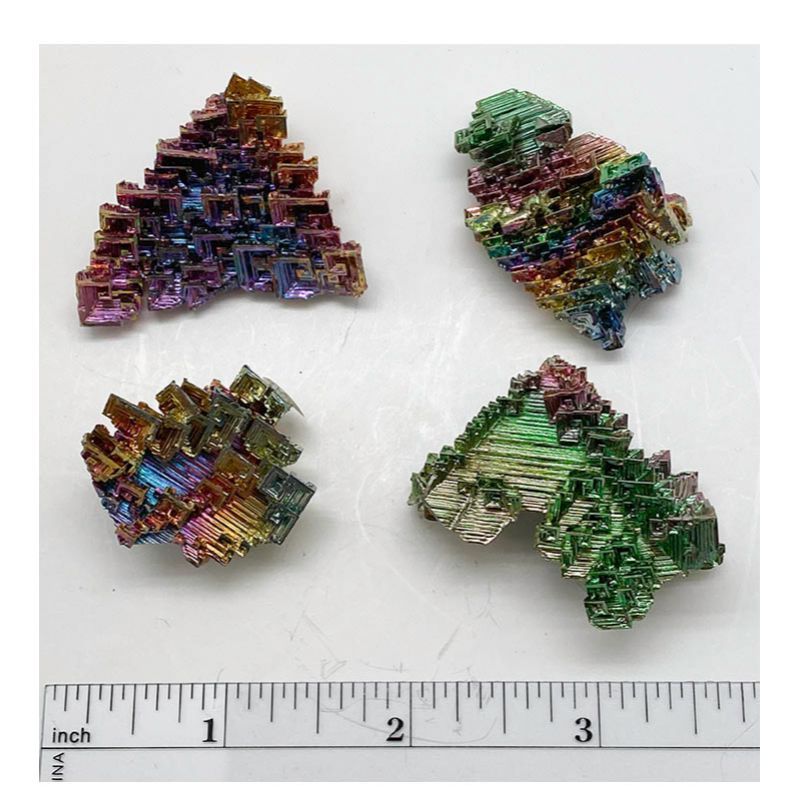
Bismuth Small
$7.00
&nb
Quantity
Online pricing always uses oprice.
Scientific
Bismuth is not often found in pure form in nature but is common in its sulfide and oxide forms and is usually obtained as a byproduct of smelting copper and lead ores. Most pure bismuth is a lab grown crystal with distinctive hopper crystal shape and iridescent color. The hopper shape is the result of the crystal growing more rapidly on the outer edges resulting in the distinctive stair step appearance. In its initial form, bismuth is a silvery white color that quickly oxidizes. Variation in thickness of the oxide layer result in the different colors seen on the crystal.
Uses
Bismuth is one of the first 10 metals discovered and was often confused with tin and lead which share some of the same characteristics. It was recognized as a separate mineral possibly as early as the mid 1500’s and the name bismuth first occurs in the mid 1600’s. Prior to that time, it was known by a variety of names including ‘silver in the making’. Bismuth was known to the Incas as they used it along with copper and tin for a special bronze alloy for making knives.
Today bismuth compounds account for about half the production of bismuth. They are used in cosmetics, pigments, and a few pharmaceuticals, (think Pepto-Bismol). Bismuth alloys are used increasingly as a substitute for lead because of its unusually low toxicity for a heavy metal. Bismuth's unusual propensity to expand as it solidifies is also responsible for some of its uses, such as in casting of printing type.
Meaning
Bismuth can relieve emotional and spiritual isolation, facilitating the meditative state of oneness, connectedness and serenity. Bismuth is useful when experiencing change, providing for calmness, vitality and orderliness. Energy is transformed from the crown chakra to the base chakra, which is something other stones do not do. It can be used on all chakras. The power of wisdom can be actualized through bismuth.
image represents a group of similar stones
SKU: 658
Stock: 7
Category: Decor & More
Tags: Stones, Bismuth
Weight: 1
Size: .5 in
No reviews yet.
You Might Also Like